News

Nominations are Now Open for the 11th Annual Barbara Laronde Emerging Artist Award Deadline January 31, 2026

This award recognizes outstanding emerging Indigenous (Status and Non-Status First Nations, Métis, Inuit) artists from Northern Ontario who are women or otherwise gender marginalized/gender diverse (transfeminine, transmasculine, non-binary, Two Spirit, gender non-conforming). You can nominate yourself or nominate another artist. The winner will receive a cash prize of $5,000, and two shortlisted artists will receive prizes of $1,500 each.

Eligibility

  • Must be 18 years of age or older
  • Must be an Indigenous person living in Northern Ontario (Métis, Inuit, Status, and Non-Status First Nations peoples) with lived experience and demonstrable connection within an Indigenous community or communities. Distant, recently discovered or rumored Indigenous ancestry alone does not make an individual eligible for this award. NWIA respects the sovereignty and self-determination of all Indigenous Nations and these nations rights to determine who their citizens are. 
  • This award is for women and other gender-marginalized folks. NWIA respects trans women as women and uses the term “gender marginalized” to be inclusive of not only women but also transmasculine, transfeminine, non-binary, Two Spirit, and genderqueer folks. Cis-gendered, heterosexual men are not eligible for this award.
  • Must be at the emerging stages of an artistic career. NWIA defines an emerging artist as:
    • In the early stages of their career, regardless of age
    • Has created a modest body of work
    • Has had some evidence of professional achievement but may not yet have a substantial record of accomplishments.
    • One who is not yet recognized as an established or mid-career artist by other artists, curators, producers, critics, community members, and arts administrators.
  • Open to all artistic disciplines including:
    • Traditional/Customary Arts (examples: Beading, Carving, Quillwork, Tufting, Weaving)
    • Visual Arts (examples: Painting, Drawing, Sculpture, Installation, and Performance Art)
    • Performing Arts (examples: Dance, Music, Theatre) 
    • Media Arts (examples: Film, Video, New Media)
    • Literary Arts (examples: Prose, Poetry, Creative-Nonfiction, Spoken-Word)
  • Live in one of these geographical regions in northern Ontario:
    • Kenora District 
    • Algoma District 
    • Cochrane District 
    • Manitoulin District 
    • Nipissing District
    • Parry Sound District 
    • Sudbury District 
    • Timiskaming District 
    • Rainy River District 
    • Thunder Bay District
  • All eligible artists are encouraged to self-nominate.
  • Individuals can also nominate an eligible artist they feel deserves this award.
  • Individuals who have been shortlisted for the award previously are still eligible to win the award.
  • Previous winners of the Barbara Laronde Emerging Artist Award are ineligible to be shortlisted or win the award again.

Please ensure your nomination includes all of the following items :

  • Artist Resume or CV
  • Short bio up to 250 words max
  • A maximum 1-page letter outlining why you, or the artist you are nominating, should receive this award.
  • Images, audio, written, or video support material of your artwork. Please do not send more than 10 individual files or any originals. 
  • Maximum 1-page letter of support from the nominator or in the case of a self-nomination, a letter from someone who is familiar with the nominee’s career in the arts. 

Nominations Open: November 14, 2025

Nomination Deadline: January 31, 2026

Value of Award: $5,000 for winner/ $1,500 for two shortlisted nominees.

Award Jury: * NWIA Board of Directors

Submit your nomination and/or inquiries directly to Native Women in the Arts at awards@nwia.ca.

Please share this call on Facebook, Twitter, and by email to family and friends!

*In the event of a direct conflict of interest between an NWIA board member and a nominee, said NWIA Board members will recuse themselves from the selection process. Examples of direct conflicts of interest include a nominee being a family member, partner, employee, or employer of a board member, A board member being from the same community/band as a nominee, or having worked in collaboration with or curated a nominee in the past would not be considered a direct conflict of interest. 

Our Vision: To support and celebrate the achievement of Indigenous gender marginalized artists from Northern Ontario, and to provide financial support and career-enhancing opportunities to encourage their continued excellence.

The Impact: The Barbara Laronde Award is given in the spirit of fostering the careers of emerging artists from Indigenous (on and off-reserve) communities in Northern Ontario. NWIA recognizes the specific barriers that many Northern artists face, and we aim to support Indigenous artists by creating connections, professional development, and exhibition opportunities through our programming initiatives. Since 1994, NWIA has delivered theater, dance, music, and spoken word presentations, exhibited visual and media arts, and published three books of Indigenous visual art and writing. We also hold community-driven artist talks, workshops, commissions, and symposiums. Our programming is offered to diverse audiences in Toronto, Northern Ontario, and online.

The History: The Barbara Laronde award was created to honour the legacy of NWIA founder Sandra Laronde, and her vision and commitment to Indigenous artists Sandra Laronde’s 19 years of leadership at NWIA paved the way for many Indigenous artists at various stages of their careers. The award is named after her mother, Barbara, who has been the backbone of her family and a leader in the Northern Ontario community, Temagami First Nation. Barbara inspired her children to be creative and entrepreneurial, and it is with this spirit that NWIA launched this award.

For more info visit: www.nwia.ca/apply.

The Ontario Arts Council (OAC) Indigenous Visual Artists’ Materials (IVAM) program now open

The Ontario Arts Council (OAC) Indigenous Visual Artists’ Materials (IVAM) program supports Ontario-based First Nations, Inuit, and Métis artists working in the visual arts, crafts or traditional/customary Indigenous art forms to create art work. Grants of $500 or $1000 help cover the cost of buying art materials and supplies. The Ontario Arts Council (OAC) partners with recommender organizations throughout the province, which receive and assess IVAM applications from artists. Recommended applications are forwarded to OAC for payment directly to the artists.

Native Women in the Arts (NWIA) is an official third-party recommender. Using Nova, OAC’s online grant application system, an artist applies to an Indigenous organization designated as a recommender for the program. These recommenders assess applications and submit grant recommendations to OAC. This program is open to artists and Culture Carriers who are First Nations, Inuit, or Métis, who reside in Ontario. 

The 2025-2026 program is open from September 2025 until January 30, 2026, 1:00 p.m. ET.

 The IVAM grant can be used for the following expenses:

  • Materials and art supplies, such as wood, fabric, thread, stone, leather hides, sinew, beads, needles, photographic printing, inks, metals, paint, canvas, paper, pencils, etc.
  • Small tools for making artwork or for harvesting or gathering materials, such as blades, carving tools, awls, scissors, etc.
  • Materials or tools required to run or participate in workshops
  • Cost of transporting or shipping materials and supplies
  • Individual travel costs for gathering materials, such as to collect beading/sewing supplies or to gather natural materials on the land

Eligible art forms include, but are not limited to:

  • basketry (birch bark, black ash, willow, etc.)
  • beading
  • birch bark work
  • carving
  • drawing
  • drums, rattles and instruments
  • glass
  • hide tanning and fur processing
  • installation
  • jewellery
  • leather work
  • metal work
  • mixed media
  • moccasin making
  • painting
  • photography
  • pottery
  • printmaking
  • quillwork
  • sculpture
  • textile art (embroidery, quilts, weaving, etc.)
  • traditional regalia
  • traditional tattooing
  • tufting
  • woodworking (snowshoe making, tamarack goose making, etc.)

To apply, complete and submit an application in Nova, OAC’s online grant application system. Before applying, you must create or update your profile in Nova.

Read the full IVAM Program requirements here: 

https://www.arts.on.ca/grants/indigenous-visual-artists-materials

Questions? Contact NWIA’s Artistic Director, Quach George, at quach.nwia.ca.

Or Maggie Lucas, OAC’s Program Administrator at mlucas@arts.on.ca.

The Ontario Arts Council (OAC) Indigenous Visual Artists’ Materials (IVAM) program supports Ontario-based First Nations, Inuit, and Métis artists working in the visual arts, crafts or traditional/customary Indigenous art forms to create art work. Grants of $500 or $1000 help cover the cost of buying art materials and supplies. The Ontario Arts Council (OAC) partners with recommender organizations throughout the province, which receive and assess IVAM applications from artists. Recommended applications are forwarded to OAC for payment directly to the artists.

Native Women in the Arts (NWIA) is an official third-party recommender. Using Nova, OAC’s online grant application system, an artist applies to an Indigenous organization designated as a recommender for the program. These recommenders assess applications and submit grant recommendations to OAC. This program is open to artists and Culture Carriers who are First Nations, Inuit, or Métis, who reside in Ontario. 

The 2025-2026 program is open from September 2025 until January 30, 2026, 1:00 p.m. ET.

To apply, complete and submit an application in Nova, OAC’s online grant application system. Before applying, you must create or update your profile in Nova.

Read the full IVAM Program requirements here: 

https://www.arts.on.ca/grants/indigenous-visual-artists-materials

Questions? Contact NWIA’s Artistic Director, Quach George, at quach.nwia.ca.

Or Maggie Lucas, OAC’s Program Administrator at mlucas@arts.on.ca.

Nuit Blanche East Danforth 2025, Presented by East End Arts, Danforth BIA, and Native Women in the Arts, Illuminates Toronto’s East End with All-Night Art, Music, and Indigenous Storytelling.

Nuit Blanche, Toronto’s sunset to sunrise celebration is the largest contemporary art event in North America. Thanks to our partners East End Arts along with the Danforth BIA, we’re presenting another all-night art experience to our East Toronto communities along Danforth Avenue, between Greenwood + Coxwell TTC Stations.

This year’s City-wide Nuit Blanche theme is Translating the City, which speaks to our desire to centre the hidden artistic stories and voices of the East Danforth neighbourhood with a focus on different languages, cultures, stories and ideas of the neighbourhood not yet explored or platformed.

On Saturday, October 4, 2025, we invite you and your families to join us for Nuit Blanche East Danforth 2025 (#NBED25), in collaboration with East End Arts, enjoy the return of the IN VIEW series, an impressive storefront gallery exhibition featuring Indigenous artist Richael Laking and Wolf⁷a:z; stop into an all-night forest-themed Silent Disco with music from DJ Kookum, and more! 

Nuit Blanche – East Danforth 25
Saturday, October 4, 2025 | 7PM – 7AM
Various locations along Danforth Avenue, between Greenwood + Coxwell TTC Subway Stations
Cost: FREE

Plan your trip by visiting the East End Arts Info Hub and online map to help you locate all of the art installations, food and drink, washrooms, and more. RSVP on Facebook. 

ART INSTALLATIONS

O’notsta’kha (Shake the Bush) – A Silent Disco Celebrating Art, Nature, and Indigenous Tradition

Location: Bomb Fitness Danforth, 1480 Danforth Ave.

O’notsta’kéha the Kanienʼkehá꞉ka (Mohawk) phrase meaning “Shake the Bush” draws inspiration from the Haudenosaunee social dance, characterized by call-and-response singing and expressive footwork. The dance symbolizes a spiritual dialogue with the natural world, evoking the stirring of life within the forest.

In a vibrant reimagining of this tradition, the event will feature music by acclaimed Indigenous DJ and sound artist DJ Kookum, known for high-energy sets and genre-bending mixes that blend hip-hop, EDM, and Indigenous sounds. 

Under the glow of the forest night, DJ Kookum’s exclusive sets will be featured on one of the three silent disco channels, adding a dynamic, contemporary edge to this deeply rooted cultural celebration.O ’notsta’kéha (Shake the Bush) is more than a dance party—it is a sensory experience that fosters reflection, connection, and celebration. It stands as a living tribute to Indigenous resilience, land-based knowledge, and the power of music to unite within the natural world.


DJ Kookum


DJ Kookum is an Indigenous-renowned DJ and producer from the Alexis Nakota Sioux Nation and based in Vancouver, BC. Known for her versatile skills and ability to transcend genres, Kookum is always cooking, keeping the atmosphere alive, fresh, and electrifying. Blending EDM, hip hop, bass music, and global sounds, Kookum creates high-energy performances that resonate with music lovers of all backgrounds. With an extensive music library, Kookum ensures each performance is tailored to the crowd, igniting a shared sense of connection through the power of music.

This international star has taken her performances across the globe, captivating audiences in Germany, Australia, Mexico, and America. Closer to home, Kookum has graced some of  Canada’s most prestigious events and festivals including Basscoast, Bastid’s BBQ, Vancouver Indigenous Fashion Week, Nuit Blanche Toronto, Ted Talks after party, and the Vancouver Michelin awards, among many others.Aside from her reputable solo career, Kookum has been DJing for the hip hop duo Snotty Nose Rez Kids for nearly a decade, performing and touring across North America.

Beyond her musical prowess, DJ Kookum is a facilitator, mentor, and motivator. By fearlessly breaking boundaries and celebrating her identity, she sets an inspiring example for aspiring DJs and producers around the world. Through her groundbreaking work and dedication, she leaves a significant mark on the music industry, proving that women play a vital role in electronic music.
 

Haƞwi – Moon in the Dakota Language

Location: Blossoming Minds, 1530 Danforth Ave.Haƞwi features a shifting projection of the moon, moving through the four sacred colours: red, black/blue, yellow, and white. These colours represent all peoples and all directions around the earth.

The moon pulls us inward while also pushing us toward the shadowed deposits of our existence. It is a reminder of the vast expanse above us, and of the unique home that nurtures the molecules from which we are all formed. The moon holds both the moments we keep quietly in private thought, and the spectacular phenomena we gather to witness together.

The moon carries a name in every language. What are the stories your grandparents told, now carried forward by you?
 

Richael Laking


Richael Laking (b.1989) is Sisseton-Whapeton of Sioux Valley Dakota Nation and Irish mix born in Toronto Ontario.

She works with acrylic and mixed media on various surfaces. Her paintings explore socio-political issues masked by the media and pop culture, as well as her own surreal world.

Her work is purely expressive and takes place between here and the intricate mysteries of the human subconscious. She invites viewers to explore the hidden meanings through each colour, texture, shape and line.
 

The Agreements of Turtle Island

Location: Jump for Joy, 1472 Danforth Ave. 

The Agreements of Turtle Island is a multimedia canvas piece centred on  the powerful image of a snapping turtle—an animal deeply rooted in the creation stories of Turtle Island, the name many Indigenous Peoples use for what is now called North America. Through layered imagery, texture, and symbolic design, this work brings forward visual narratives of peace, governance, and shared responsibility for the land.

The turtle, long revered as a foundational being, carries not only the earth in its cultural significance, but also the layered agreements that have shaped our collective presence on these lands. A symbolic belt encircles the turtle’s form—an echo of historic treaty relationships between First Peoples and settlers, rooted in mutual respect, care, and stewardship.

This piece is a visual reminder that these original agreements were not only made between human nations, but also with the Earth itself. Today, everyone who calls these lands home is called to honour those original understandings—to care for and protect our shared home, Mother Earth.

In Indigenous worldviews, life moves in cycles. The Earth is not a commodity, but a living relative with whom we are in constant relationship. Humans are not above nature, but part of a vast web of interdependence—one that includes the waters, winds, animals, plants, insects, and stars. Each holds meaning. Each plays a role. As the two-legged, we are called to uphold our responsibilities with humility, respect, and care for all living beings. 

Key elements in this artwork include:

  • The Great Tree of Peace, with an eagle perched above and weapons buried beneath its roots—an emblem of the Great Law of Peace, the founding constitution of the Haudenosaunee Confederacy. This law is one of the world’s oldest participatory governance systems and promotes values of unity, peace, and collective responsibility. The eagle atop the tree serves as a guardian, watching for danger and reminding us to protect the peace. The act of burying weapons beneath the tree symbolizes the end of conflict and a commitment to peaceful coexistence. Rooted in deep spiritual and philosophical teachings, the Great Law established a system of governance based on consensus, respect for diversity, and the well-being of future generations.
  • The Haudenosaunee Confederacy belt, representing the unity of the Six Nations: Mohawk, Oneida, Onondaga, Cayuga, Seneca, and Tuscarora.
  • Recognition of the traditional caretakers of the Toronto area, including the Haudenosaunee, the Huron-Wendat, the Mississaugas of the Credit, and the Anishinaabe.
  • The One Dish, One Spoon, One Bowl agreement, a longstanding treaty between the Haudenosaunee and the Anishinaabe.

 It teaches three core principles:

  1. Take only what you need
  2. Leave some for others
  3. Keep the dish clean

The Agreements of Turtle Island is a multimedia canvas piece that depicts the alligator snapping turtle, a key figure in Indigenous creation stories of Turtle Island (North America). Layered imagery reflects themes of peace, treaty relationships, and shared responsibility for the land. The work invites reflection on our interconnectedness with the Earth and a call to honour original agreements grounded in respect, care, and balance.


Wolf⁷a:z


Wolf⁷a:z is a Haudenosaunee Two-Spirit artist from the Gayogohó:nǫ⁷ Nation of Six Nations of the Grand River. For over 18 years, they have developed a multidisciplinary practice that spans public mural installation, carving, jewelry, fabrication, welding, and epoxy resin work—deeply rooted in their heritage and lived experience. Through their murals, they actively promote the revitalization of the Gayogohó:nǫ⁷ (Cayuga) language, incorporating it into each project and donating 10% of profits to a language program within Six Nations. Their goal is to Indigenize urban spaces and foster empathy, kindness, and respect through visual storytelling. Wolf⁷a:z has painted murals in Canada, the U.S., Scotland, England, Mexico, and Germany. One of their interactive works in Hamilton features a QR code linking to their YouTube channel, where viewers can hear Cayuga & Mohawk spoken. Their work was featured in The Concrete Canvas Graffiti Book (2023), and they were honoured with the Toronto Arts Foundation Indigenous Artist Award in 2025.


FUNDERS AND PRESENTERS

NUIT BLANCHE TORONTO

Nuit Blanche was originally conceived in Paris, France in 2002, with a mandate to bring contemporary art to large and diverse audiences in public spaces. In 2006, the producers of the founding Nuit Blanche from the City of Paris invited the City of Toronto to join an assembly of more than six founding European cities producing similar art and cultural events. Toronto was the first North American city to model itself based on the City of Paris Nuit Blanche, and has since inspired similar celebrations. The Toronto event is produced by the City of Toronto.

Nuit Blanche Toronto is a free, 12-hour contemporary art event that has a mandate to connect contemporary art to the broadest possible publics and to create opportunities for audiences to explore and engage with contemporary art in public space.

The 19th annual Nuit Blanche Toronto will transform the city’s neighbourhoods and streets on the first day of fall with dazzling art installations, from 7 p.m. on Saturday, October 4 to 7 a.m. on Sunday, October 5. Featuring three exhibitions located in North York, Etobicoke and downtown and more than 85 works by local, national and international artists, the city becomes a living book created not just with words, but through sights, sounds, movements and shared spaces. Entry will be free for the public to engage with the art projects.

Since 2006, this award-winning event has featured almost 1,600 art installations by approximately 5,800 artists and has generated over $489 million in economic impact for Toronto. Browse past art projects. This year’s event hashtag is #NBTO25.

EAST END ARTS

East End Arts is a non-profit community arts organization that serves the east end of Toronto. We provide inclusive arts programming, events and services to our local communities, and we provide professional development opportunities to both emerging and established artists and arts organizations. Our vision is to unite, inspire and enhance the communities of east Toronto with the transformative power of the arts.THE

DAN FORTH MOSAIC BIA

The Danforth Mosaic BIA has everything you need within walking distance on Danforth-East between Jones Avenue and Westlake Avenue. We’re a true mosaic of people and Cultures. The BIA works in partnership with the City to create thriving, competitive, and safe business areas that attract shoppers, diners, tourists, and new businesses. Their vision is to create a vibrant and well-maintained business area with diverse shopping and dining opportunities and services to attract the local community as well as visitors.

NATIVE WOMEN IN THE ARTS

Native Women in the Arts (NWIA) is a not-for-profit organization for First Nations, Inuit and Métis women and other Indigenous gender marginalized folks who share the common interest of art, culture, community and the advancement of Indigenous peoples.

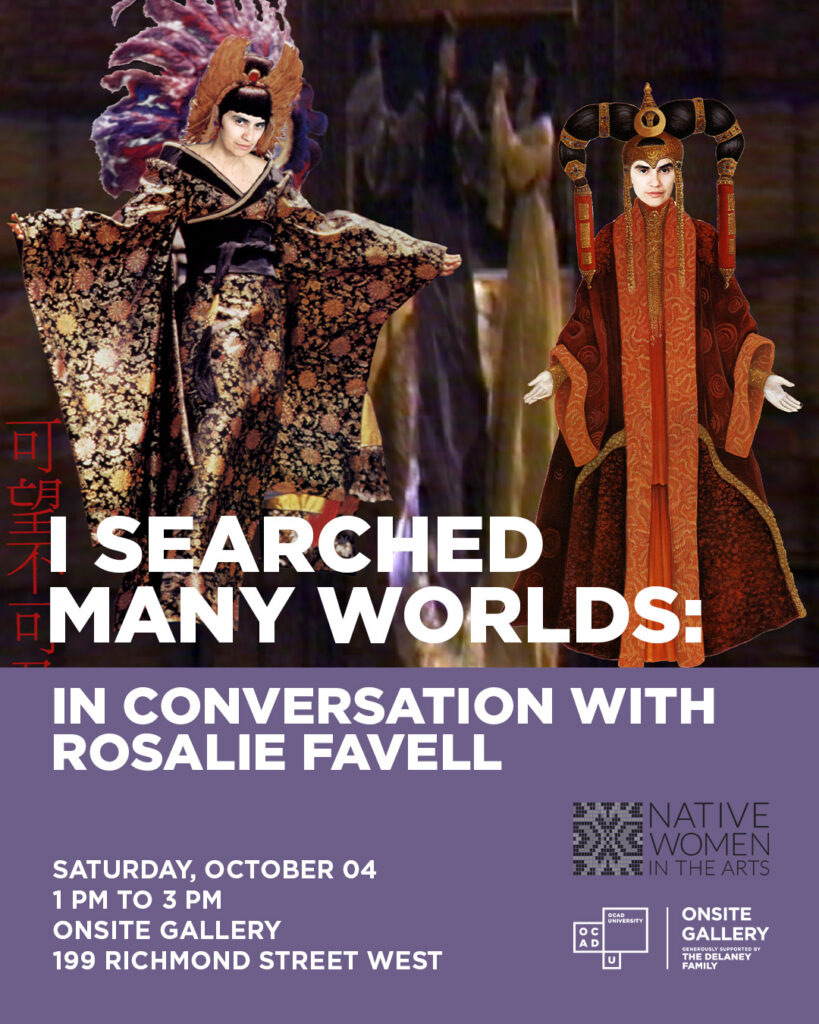
Join us for an in-depth conversation between artist Rosalie Favell, art historian Michelle McGeough, and Ryan Rice, Executive Director and Curator, Indigenous Art at Onsite Gallery.

In conjunction with the exhibition Rosalie Favell | Belonging (1982–2024), this special event delves into the expansive forty-year artistic journey of Rosalie Favell through dialogue centered on her lens-based practice. The conversation will reflect on the curated works featured in the retrospective that foreground themes of identity, belonging, personal discovery, and the complex intersections of Indigenous, 2SLGBTQ+ and Canadian experiences and histories.

Co-presented by Native Women in the Arts.

Admission is free and open to all. 

Seating is limited—RSVP required. Visit Registration Page

A reception will follow.

Rosalie Favell is a distinguished Red River Metis artist who has achieved national and international acclaim, with a creative practice spanning over 40 years. Favell has used portraiture in photography, painting, and video to understand and represent her ancestry and identity in works that have been exhibited and collected nationally and internationally. Drawing inspiration from her family history and Red River Metis heritage, she uses a variety of sources, from family albums to popular culture, to present a complex self-portrait of her experiences as a contemporary Indigenous woman.

Dr. Michelle McGeough (Cree /Métis and Settler) is originally from Amiskwaciwâskahikan, located in the Treaty Six region of what is presently referred to as Alberta. Dr. McGeough’s family names are Berard, Moreau, Belcourt, dit Sapin and L’hirondelle. Her father was from Northern Ireland. Michelle is currently an Associate Professor at Concordia University. She received her Ph.D. in Indigenous art histories from the University of New Mexico. Dr. McGeough’s research interests have focused on the Indigenous two-spirit/Indigiqueer identity.

Ryan Rice, Kanien’kehá:ka of Kahnawake, is a Toronto-based curator, critic, and creative consultant. With a curatorial career spanning over 30 years, he has worked across communities, museums, artist-run centres, public spaces, and galleries. Rice currently serves as Executive Director and Curator, Indigenous Art at OCAD University’s Onsite Gallery. He is the 2025 recipient of the Toronto Arts Foundation’s Margo Bindhardt and Rita Davies Cultural Leadership Award.

Onsite Gallery is OCAD University’s flagship professional gallery, dedicated to presenting contemporary, Indigenous, and public art and design. It serves as a platform for advancing knowledge creation through creative and curatorial practices to stimulate local and international conversations on urgent issues of our time.Native Women in the Arts (NWIA) is a not-for-profit organization for First Nations, Inuit and Métis women and other Indigenous gender marginalized folks who share the common interest of art, culture, community and the advancement of Indigenous peoples.

Rosalie Favell | Belonging (1982 – 2024) is the first retrospective of renowned Red River Metis artist Rosalie Favell, showcasing a powerful curated selection of her lens-based works from 1982 to 2024. This exhibition celebrates Favell’s groundbreaking photographic practice—from seminal series like Living Evidence and Plain(s) Warrior Artist to her expansive archive Facing the Camera—which invites us to bear witness and explore the complex themes of identity, empowerment, same-sex desire, community and the nuanced search for belonging through a lens that is both deeply personal and subtly subversive.

Image Credit: Rosalie Favell, I searched many worlds (from Plain(s) Warrior Artist series), 1999, inkjet print. Courtesy of the artist.

Onsite Gallery is generously supported by The Delaney Family.

Native Women in the Arts is proud to introduce the winner and five shortlisted recipients of the 10th Annual Barbara Laronde Award

The Barbara Laronde Emerging Artist Award recognizes outstanding emerging Indigenous (Status and Non-Status First Nations, Métis, Inuit) artists from Northern Ontario who are women or otherwise gender marginalized (transfeminine, transmasculine, non-binary, gender non-conforming, Two Spirit). NWIA recognizes the specific barriers that many Northern artists face, and we aim to support Indigenous artists from Northern Ontario by creating connections, professional development, and performance opportunities through our programming initiatives. 

This year’s award winner is Amber Waboose, who will receive a $5,000 prize and be featured on our website in the coming weeks.

Each of the shortlisted artists—Emily Granville, MJ Singleton, Grace Swain, Chevaun Toulouse, and Colleen Toulouse—will receive a $1,500 award in recognition of their outstanding work and artistic promise.

Winner: Amber Waboose

Amber Waboose (Odemin Mkwaa Kwe) is an Ojibwe artist from Batchewana First Nation, Ontario. She practices various art forms, including porcupine quillwork on birchbark and two-dimensional and diverse arts. Through her quillwork, Amber creates both jewelry and visual art. Nature often inspires her designs, featuring birds, flowers, berries, bees, moths, fish, and various animals. She harvests and processes all the materials used in her quillwork. Being in nature gives her peace and a deep connection to her culture. Amber’s work is grounded in the philosophy that everything in the universe is interconnected. A common theme in her paintings is interconnection, depicting the lands, water, sky, and stars. After her introduction to quillwork, you will see elements such as birch bark and sweetgrass in her artwork. Her paintings draw inspiration from her personal experiences, ceremonies, and dreams.

Shortlist: Emily Granville

Emily Granville is an Odawa-Cree musician from Wiikwemkoong Unceded Territory on Manitoulin Island. After attending Cambrian College for Music Performance in piano, Emily is now graduating from the Bachelor of Music program at Laurier. Emily has an interest in composition, collaborative performance, and ethnomusicology from an Indigenous lens. Most recently, Emily has performed, directed, produced and composed their own piece through the Paprika Theatre Festival, performed at the Northern Ontario Music and Film Awards, and volunteers as a piano teacher for the Community Music School of Waterloo Region. Emily is excited to be furthering their education in the MA Ethnomusicology program at The University of British Columbia in the fall.

Shortlist: MJ Singleton

MJ Singleton is a two-spirit Ojibwe artist from Eagle Lake First Nation in the Kenora District. Their artistic repertoire consists of painting, digital illustration, beading and sewing. MJ’s designs for the university’s orange shirts for Truth and Reconciliation Day 2023 and 2024 raised over $54,000 for the Orange Shirt Society, striving to amplify Indigenous voices, and igniting meaningful dialogue towards reconciliation. MJ is a fourth year student at University of Toronto Mississauga, double majoring in Psychology and Criminology, Law & Society. 

Shortlist: Grace Swain

Grace Swain is an Indigenous advocate, artist, and communications professional from Swan Lake First Nation on her father’s side (Treaty One, MB) and Wiikwemkoong First Nation on her mother’s side (ON). She creates Woodland-style art inspired by her Anishinaabe roots and is passionate about breaking down barriers for Indigenous artists. Grace curates art for Café 4 Good in Sault Ste. Marie, supporting Indigenous youth, and serves on the Creation Advisory Circle for Indigenous Youth Roots (IYR).

Shortlist: Chevaun Toulouse

Chevaun Toulouse is an Anishinabekwe from Sagamok Anishnawbek and a member of the Ginoozhe (Pike) clan. Growing up in Sagamok gave her an interest in and respect for the environment, as much of her youth was spent trying to catch turtles and snakes in the swamp. Whether snatching snakes or catching turtles, it was on the land interacting with reptiles and amphibians that she found her passion. She recently graduated with an Honours BSc in Indigenous Environmental Studies and Biology from Trent University, building on previous education in conservation, Indigenous environmental leadership, and naturalist research.

Shortlist: Colleen Toulouse

Colleen Toulouse is Anishinaabe from Sagamok Anishnawbek. She is an educator, journalist, and a proud grandmother of two boys. Colleen has written numerous articles for local newspapers, been published in magazines and books, and enjoys writing poetry and short stories. Her most recent story, The True Reflection of the Magpie and the Seed is featured in Indigenous Voices of Canada: Heart, Hope and Land, published by the International Human Rights Arts Movement Literary Magazine Press. Colleen values First Nations stories as a source of learning and understanding her culture. She continuously embraces her life-long learning journey.

We once again extend our heartfelt congratulations to the winner and shortlisted recipients of this year’s Barbara Laronde Award. If you’d like to support the next generation of emerging Indigenous women and gender-diverse artists, please consider donating to the Barbara Laronde Award.